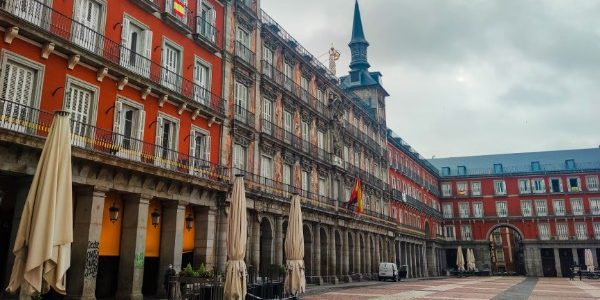
The situation in Madrid after the end of the State of Alarm, with the measures approved by the CAM.
The Community of Madrid wants the return to normal to be carried out gradually and with the maximum possible security and prudence. In this sense, it calls on the responsibility of each and every one of the Madrid residents to follow all the guidelines for self-protection, mainly, the maintenance of social security distance, the use of masks and regular hand washing, as well as other hygienic and sanitary measures.
This regulation will be maintained throughout the Community of Madrid, until the Spanish Government declares the end of the health crisis situation caused by COVID-19. Also depending on the epidemiological evolution, the health authorities of the Regional Ministry of Health may modify, suppress or extend actions.
This plan responds to the measures announced for the aftermath of the State of Alert at the national level.
Summary of these measures
In summary, these measures are:
- A first phase is established from June 21 to July 5. And a second one from July 6th.
- The responsibility of the people of Madrid is appealed to with the use of the mask, the interpersonal distance 1.5m or the fulfillment of hygienic measures.
- The capacity in closed spaces will generally be 60% and from July 6, 75%.
- In open areas, mainly terraces, the occupation will be 80%. And in the second phase 100%, maintaining social distance.
- Children’s Schools will open from July 1st and priority will be given to students whose parents work outside the home.
- The regional government will make the activity and visits in the social health centres more flexible with a new protocol that will come into force on 21 June.
- The recreational and municipal swimming pools, together with the hostels, will maintain a maximum capacity of 50% for the time being.
- Public transport will provide 100% of its offer at peak times.
Madrid after the end of the State of Alarm
The above-mentioned Order establishes the two phases for the Community of Madrid. And the nuances and restrictions for certain sectors.
Tourist Accommodation, Restoration and Leisure
In hotels and restaurants, between 21 June and 5 July, 60% of the capacity of the interior will be allowed to be occupied. Both in tables and at the bar. And 80% of the authorised capacity for the terrace.
From 6 July, the entire terrace and 75% of the interior capacity can be used.
Consumption inside the premises may take place at the bar or sitting at a table or group of tables. The maintenance of a safety distance of 1.5 metres between customers must be ensured. Or, where appropriate, groups of customers located at the bar or between tables. The maximum occupancy will be 25 people per table or group of tables.
The maximum general schedule will be from 8:00 in the morning to 1:30 in the morning. From the date of entry into force of the approved Order until 15 October 2020, both dates included. Without prejudice to the powers of the respective local councils to reduce or extend the corresponding schedule of activity. For this period, local councils may authorise the extension of terrace closing times to 2.30am in establishments located in non-residential areas.
As for hotels and tourist accommodation, until 5 July the occupation of common areas may not exceed 60% of their capacity. This can be up to 75% from 6th July. The animation activities or group classes must be designed and planned with a maximum capacity of 20 people. They will be held preferably in the open air and will avoid the exchange of material. Hostels will have a 50% occupation until further notice.
Discos and night bars will be closed until 5th July. When they are opened they will do so under the conditions determined by the General Directorate of Public Health.
Shopping malls and street markets
In shopping centres and parks open to the public, until 5 July, the capacity will be limited to 60% of their common areas. From July 6, the occupancy rate will be increased to 75%.
All accesses to the shopping centre must be kept open whenever possible. In order to avoid crowding and to limit the stay in common areas, furniture elements that have a rest purpose will be removed or disabled. Such as benches, armchairs or similar. Except for those strictly necessary for the care of elderly or dependent people.
The markets will have a capacity limit of 60% in the first stage and from July 6th it will increase to 75%. In this case, the city councils will be able to:
- Increase the surface area of the market.
- Move its location.
- Make new days available for the activity.
- Provide for alternate operation of the authorized stalls or extend their opening hours.
The movement of people and the distribution of spaces must be organised. As far as possible, itineraries will be established to direct the movement of customers and users, thus avoiding crowds.
In addition, retail and professional service establishments and premises open to the public shall be cleaned and disinfected at least twice a day. Water-alcoholic gel dispensers shall also be made available to the public.
Work and Hygiene Measures
A minimum safety distance of 1.5m must be maintained and frequent and correct hand cleaning must be carried out.
All persons over the age of 6 are obliged to wear a mask. Both on public roads and transport and in open spaces and any closed space for public use or that is open to the public. In establishments, payment by card or other means that do not involve physical contact between devices will be promoted.
At work, the arrangement of posts, the organisation of shifts and other existing working conditions will be modified. To guarantee the possibility of maintaining the interpersonal safety distance of 1.5m between employees.
In the case of services that do not allow the interpersonal safety distance to be maintained, protective equipment appropriate to the level of risk must be used. That ensures the protection of both the worker and the client. Such as
- the hairdressers.
- aesthetics or physiotherapy centres.
The work centres must also make the necessary adjustments in the time organization to avoid the risk of massive overlapping of people. All employees must have a permanent supply of soap and water, or hydroalcoholic gels or disinfectants in the workplace.
Cultural activities and shows
Libraries, archives, museums, exhibition halls and monuments will have a maximum capacity of 60% until 5 July. From July 6th it will be 75%.
Group visits will be of a maximum of 25 people, including the monitor or guide. As far as possible, the use of exhibition elements designed for tactile use by the visitor will be avoided.
Cinemas, theatres, auditoriums, tent circuses and similar spaces will be able to carry out their activities with pre-assigned seats and without exceeding 60% of the capacity allowed in each room until 5 July. From July 6th the limit will be 75%.
Until 5 July, the multi-purpose rooms and spaces may not exceed 20% of the permitted capacity. This will be increased to 50% from 6 July, but with pre-assigned seats.
On the other hand, in the bullrings, enclosures and bullfighting facilities, 60% of the authorised capacity may be occupied until 5th July, and with pre-assigned seats. From July 6th, the maximum occupation will be 75% of the capacity. Provided that the public remains seated and the safety distance of 1.5m between attendees or the use of a mask is complied with. The sale of drinks or food will not be permitted on an itinerant basis within the square and the cushions must be disinfected after each use.
Filming may be carried out in studios and private spaces after the evaluation of occupational risks and the adoption of preventive measures. In public spaces, municipal authorisation is required. Closed areas should be cleaned and disinfected before filming and professional equipment should be reduced to the essential.
Parties, festivals and other popular events may resume their activity when the health authority allows it. According to the evolution of the epidemiological situation and with the conditions established at the time.
Transport
In the area of transport, the mandatory use of masks is maintained for both passenger and freight transport. For those over 6 years of age without exception, except in cases established by the Health Department.
In public road passenger transport services under the auspices of the Madrid Regional Transport Consortium, the possibility of occupying 100% of the available seats is maintained. Except for the row behind the driver in those vehicles that do not have a screen.
- In the areas enabled to travel on foot, the occupation reference is extended from 2 to 3 people per square metre.
- In any case, it is still remembered that care must be taken to ensure that people keep as much distance from each other as possible.
For private and complementary private transport of persons in vehicles with up to 9 seats. The obligation for all passengers in the vehicle to reside at the same address in order to occupy all seats is eliminated. And it is allowed to occupy all the seats, instead of only two seats per row of seats.
In public passenger transport in vehicles with up to 9 seats (Taxis and VTC). The limitation of two passengers for each row additional to the driver’s row is eliminated and an occupation of up to three persons per row of seats is allowed. Whether or not they live together at the same address. The limitation that prevents occupying the seat of the co-driver is maintained. In the case of goods vehicles, the maximum occupancy of the vehicle is permitted.
As for the public transport offer, a service level of 100% of the available offer is established at peak times. That, in any case, will be adapted to the evolution of the demand as established by the Regional Transport Consortium, after a report from the General Directorate of Public Health.
Finally, it is agreed that the City Councils, in the exercise of their powers, will be responsible for regulating the level of taxi service. In accordance with the health recommendations existing at any given time and taking into account the considerations of the sector.
Arrabe Integra
Business Consultants